35 Years with " the United Nations Convention on the Rights of the Child " – It's Time to Give Young People Real Influence
the United Nations Convention on the Rights of the Child affirms every child’s right to life and development, a safe upbringing free from violence, a good education, meaningful leisure activities, and the right to participate in matters that affect them.
Yet, despite this, we rarely hear children’s voices in political discussions or in public debate.
This year, “ the United Nations Convention on the Rights of the Child ” turns 35, and it has been a Swedish law since 2020. It is high time we take responsibility and give children and young people a real say. To uphold the rights of all children and show that we take “ the United Nations Convention on the Rights of the Child ” seriously, it is not enough for us to work for the children—we must work together with them.
This year's Youth Barometer report shows that more and more young people feel that they have little or no opportunity to influence society. At the same time, political engagement among young people and their confidence in politicians' ability to tackle societal challenges is declining.
Five years ago, Erikshjälpen started its first "Erikshjälpen Framtidsverkstad". Today, we work in six neighborhoods and engage children, young people and parents to equalize unequal growing conditions.
During Almedalen, we were on site at Barnrättstorget together with young people from “ Erikshjälpen Framtidsverkstad ” in Gränby, Uppsala. In two seminars, we highlighted experiences and lessons learned from our first five years. Together with politicians and other community leaders, we discussed how to create opportunities for young people to participate in public discourse, as well as how Erikshjälpen Framtidsverkstad encourages and supports young people’s desire to change society.
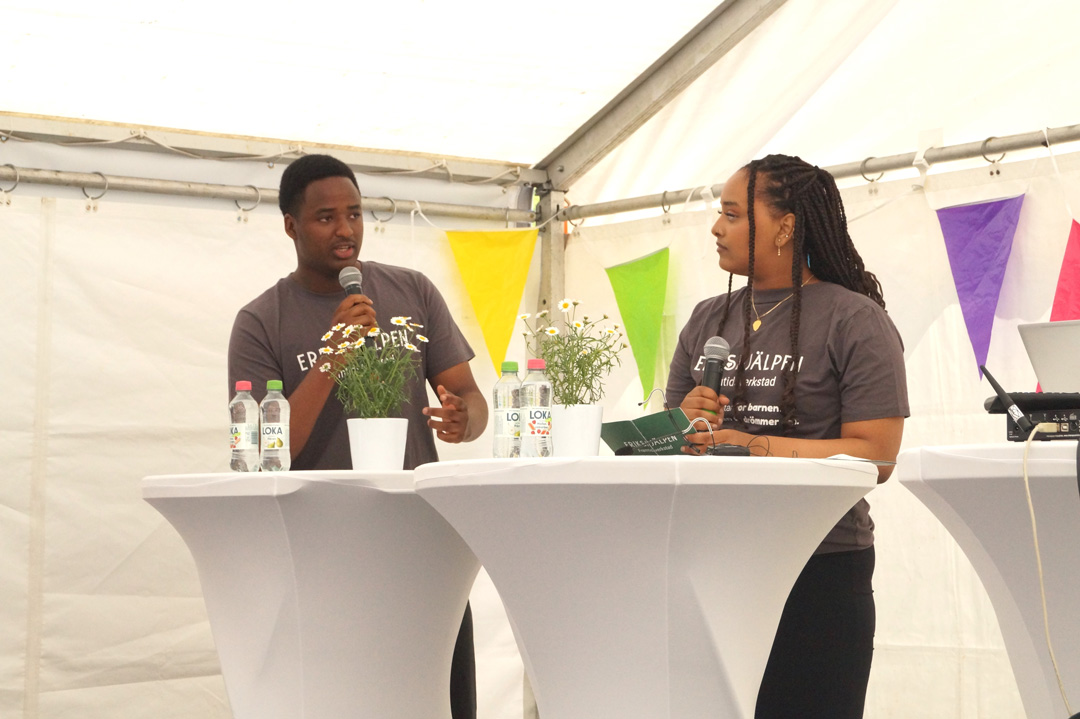
Godwin Coyitungiye and Zahara Siraj from Erikshjälpen Framtidsverkstad in Uppsala are on site in Almedalen.
Godwin Coyitungiye and Zahara Siraj from Erikshjälpen Framtidsverkstad in Uppsala are on site in Almedalen.
The need for both urgent and long-term solutions to equalize growing conditions and reduce social inequalities is obvious. Not least to prevent more young people from being recruited into criminal gangs. The government has also come up with several action plans in the area, both repressive and preventive. We at Erikshjälpen are concerned that some of the repressive proposals risk reducing confidence in both authorities and other social actors. But also lead to increased discrimination and stigmatization, something we also highlighted at our seminars in Almedalen.
It is not only about the future of our young people, but also about the life they deserve to live today. A life in a democratic and safe society with equal conditions where they can feel confident about the future. If there is one thing that Erikshjälpen Framtidsverkstad has learned during its first years, it is how crucial it is for children and young people to be involved in identifying solutions to meet the challenges facing society. This applies to all areas related to crime, increasing inequality, segregation, exclusion and the increased mental health we see throughout the country.
The consequences of segregation are clearly visible in reports and statistics. Opinions on the causes and solutions to the problems vary. But for those of us who meet children every day, it is clear how powerful the power of change is when we involve them.
So let's listen to children and give them the voice they deserve. It is not just a matter of fairness, but a necessity if we are to break the downward spiral together and create a stronger and more democratic society.
Author:
Mattias Ingeson
Secretary General, Erikshjälpen
Birgitta Johansson
Head of Sweden, Erikshjälpen
Published: 28 June 2024
 Listening