In the fall budget, the government is making significant cuts to Sweden's international aid, removing an additional SEK 3 billion per year from 2026-2028.
- As a child rights organisation , Erikshjälpen is deeply concerned about the decisions that are now being made for aid policy, says Mattias Ingeson, Secretary-General of Erikshjälpen. The government is once again backing away from its global responsibility. Further reducing aid means that Sweden will most likely not be able to meet its international commitments. Only a small part of the global goals are expected to be achieved by 2030.
The cuts are visible in area after area. Climate, peace work, aid, gender equality, trade and not least daring to demand that Corporate take responsibility for human rights.It is now more important than ever that Erikshjälpen continues to work in the hard-hit countries that the government chooses to leave to their fate.
As a child rights organisation , Erikshjälpen is deeply concerned about the decisions now being made for aid policy.
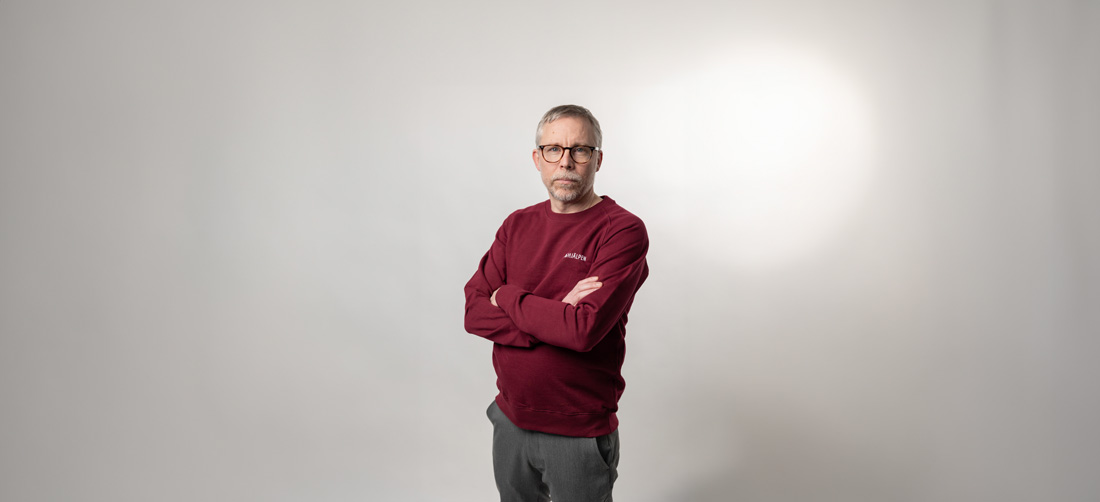
Mattias Ingeson, Secretary General of Erikshjälpen
Mattias Ingeson, Secretary General of Erikshjälpen
New government decision for Sida support
In the same week as the autumn budget was presented, the government also decided on a new strategy for support to civil society (the CIVSAM strategy). The strategy is valid between 2025-2029 and it is through this that Erikshjälpen and other civil society organizations receive support for their activities.
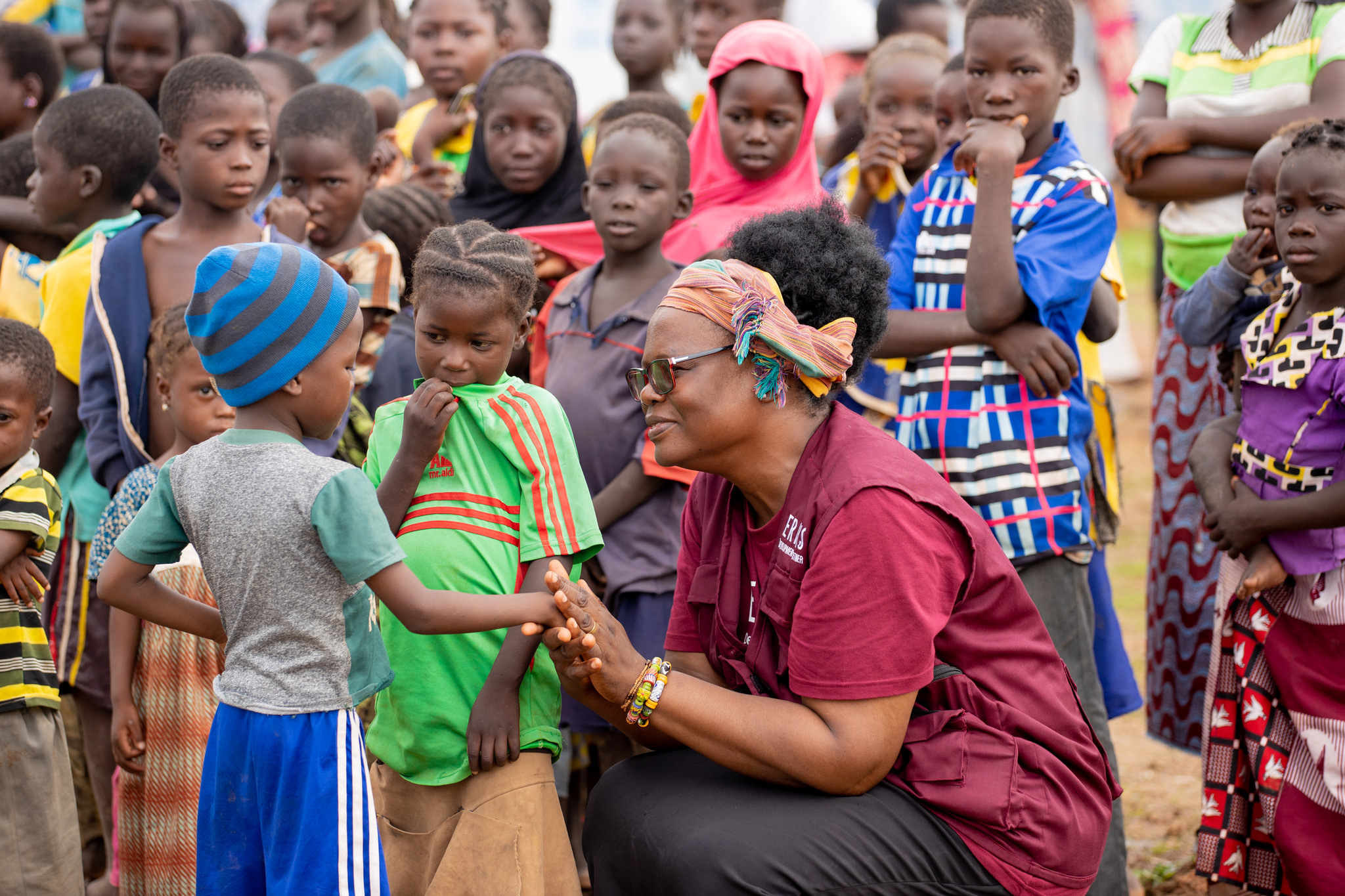
The situation in Burkina Faso is one of the world's most forgotten conflicts. The country is one of those that the Swedish government is leaving, but where Erikshjälp's interventions continue.
The situation in Burkina Faso is one of the world's most forgotten conflicts. The country is one of those that the Swedish government is leaving, but where Erikshjälp's interventions continue.
Erikshjälpen is cautiously positive about the new strategy. The government will continue to emphasize the rights of women and girls, an area that Erikshjälpen prioritizes in many of its interventions. An area that Erikshjälpen prioritizes in several of its interventions. The following lines also give hope for the future:
"It is by investing in the younger generation that aid can help lay the foundations for longer-term positive change in the welfare of poor countries. For this reason, attention should also be given to activities that include children, their experiences and life situations."
- "The doors for continued support to Erikshjälpen are still open," says Mattias Ingeson. "Now Sida can decide who will be allowed to apply for funding for next year and beyond. We hope for a positive decision within a few weeks.
We hope for a positive decision within a few weeks.
the United Nations Convention on the Rights of the Child affirms every child’s right to life and development, a safe upbringing free from violence, a good education, meaningful leisure activities, and the right to participate in matters that affect them.
Yet, despite this, we rarely hear children’s voices in political discussions or in public debate.
This year, “ the United Nations Convention on the Rights of the Child ” turns 35, and it has been a Swedish law since 2020. It is high time we take responsibility and give children and young people a real say. To uphold the rights of all children and show that we take “ the United Nations Convention on the Rights of the Child ” seriously, it is not enough for us to work for the children—we must work together with them.
This year's Youth Barometer report shows that more and more young people feel that they have little or no opportunity to influence society. At the same time, political engagement among young people and their confidence in politicians' ability to tackle societal challenges is declining.
Five years ago, Erikshjälpen started its first "Erikshjälpen Framtidsverkstad". Today, we work in six neighborhoods and engage children, young people and parents to equalize unequal growing conditions.
During Almedalen, we were on-site at Barnrättstorget together with young people from “ Erikshjälpen Framtidsverkstad ” in Gränby, Uppsala. In two seminars, we highlighted experiences and lessons learned from our first five years. Together with politicians and other stakeholders, we discussed how to create opportunities for young people to participate in the public debate, as well as how “ Erikshjälpen Framtidsverkstad ” encourages and safeguards young people’s desire to change society.
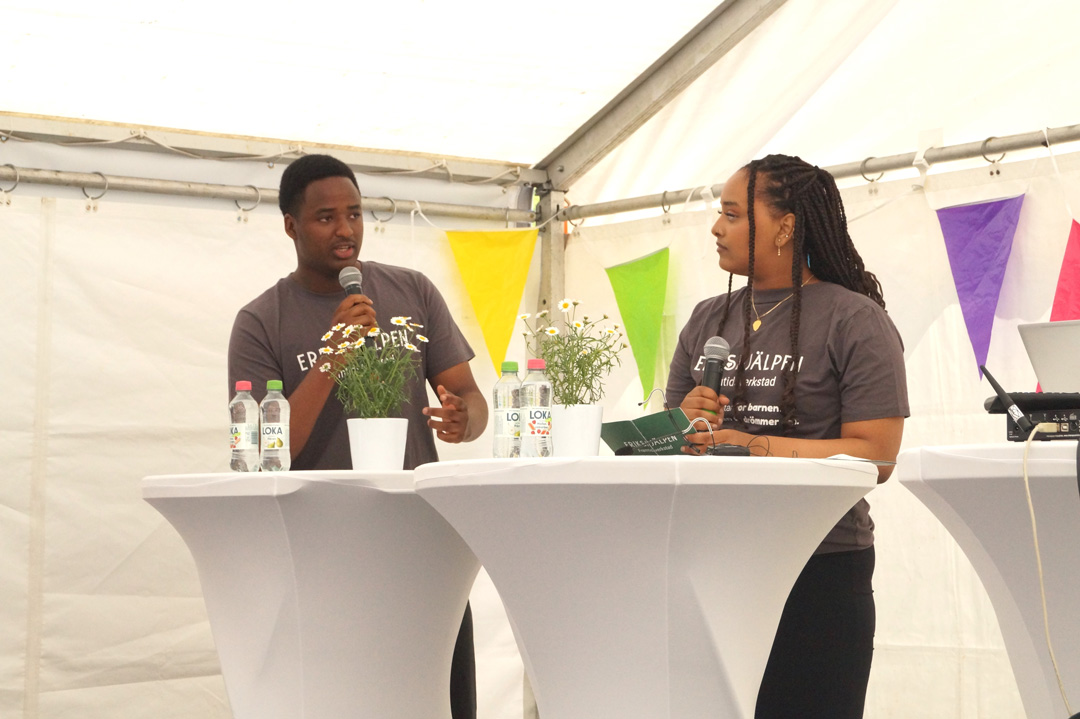
Godwin Coyitungiye and Zahara Siraj from Erikshjälpen Framtidsverkstad in Uppsala are in Almedalen.
Godwin Coyitungiye and Zahara Siraj from Erikshjälpen Framtidsverkstad in Uppsala are in Almedalen.
The need for both urgent and long-term solutions to equalize growing conditions and reduce social inequalities is obvious. Not least to prevent more young people from being recruited into criminal gangs. The government has also come up with several action plans in the area, both repressive and preventive. We at Erikshjälpen are concerned that some of the repressive proposals risk reducing confidence in both authorities and other social actors. But also lead to increased discrimination and stigmatization, something we also highlighted at our seminars in Almedalen.
It is not only about the future of our young people, but also about the life they deserve to live today. A life in a democratic and safe society with equal conditions where they can feel confident about the future. If there is one thing that Erikshjälpen Framtidsverkstad has learned during its first years, it is how crucial it is for children and young people to be involved in identifying solutions to meet the challenges facing society. This applies to all areas related to crime, increasing inequality, segregation, exclusion and the increased mental health we see throughout the country.
The consequences of segregation are clearly visible in reports and statistics. Opinions on the causes and solutions to the problems vary. But for those of us who meet children every day, it is clear how powerful the power of change is when we involve them.
So let's listen to children and give them the voice they deserve. It is not just a matter of fairness, but a necessity if we are to break the downward spiral together and create a stronger and more democratic society.
Author:
Mattias Ingeson
Secretary General, Erikshjälpen
Birgitta Johansson
Head of Sweden, Erikshjälpen
In a debate article published on altinget.se, Erikshjälpen and 34 other civil society organizations call on the Swedish government to raise the ambitions of the work with Agenda 2030 if we are to achieve the global goals.
Both the Swedish parliament and the EU have decided that Sweden should pursue policies that contribute to the implementation of the 2030 Agenda. 22 civil society organisations have together reviewed the government's work on the global goals. The results are presented in the member platform Concord Sweden's "Barometer 2024".
In 24 policy areas, only in one has the government made a clear positive contribution. In 11 areas, they have both contributed to and hindered equitable development, or done nothing at all. In 12 areas, they have worked against equitable and sustainable development.
- Sweden should be a leading nation when it comes to implementing coherent policies. The fact that the government's policy only contributes positively in a single area must change, otherwise there is no possibility to fulfill our commitments, says Anders Malmstigen, International Director of Erikshjälpen.

Anders Malmstigen, International Director of Erikshjälpen
Anders Malmstigen, International Director of Erikshjälpen
Now Concord, together with Erikshjälpen and 34 other organisations , writes in a debate article on altinget.se, that Sweden must raise its ambitions in order to achieve the global goals.
Read the full debate article here
Read the full 2024 Barometer here
In Sweden Overshoot Day, Sunday, April 21, we Swedes have used up our annual budget of the Earth's natural resources. If everyone on the planet lived like us, there would be nothing left after today.
It certainly doesn't sit well with the oft-quoted Brundtland Commission definition of sustainable development;
"Sustainable development is development that meets the needs of the present without compromising the ability of future generations to meet their own needs".
Since the UN report was published, we have been repeating this sentence like a mantra, but not much has improved when it comes to our consumption levels. Quite the opposite, in fact. Material consumption in Sweden is as high as 25 tons per person per year, or 70 kg per day. In 2020, the mass of man-made materials was found to have exceeded the mass of all living things on the planet. The fact that we are facing a planetary crisis is a fact.
The fact that Sweden's Over Shoot Day falls earlier and earlier in the year shows that the transition to a circular economy is not happening fast enough. The question is, what do we need to do to speed up the process? There is often talk of a generation gap in the climate debate, but when it comes to consumer advocacy , studies show that gender is a more crucial factor. Men and women generally have different views on climate change, their own consumption and how they contribute to emissions. And they contribute differently to climate emissions through their consumption and lifestyle choices.
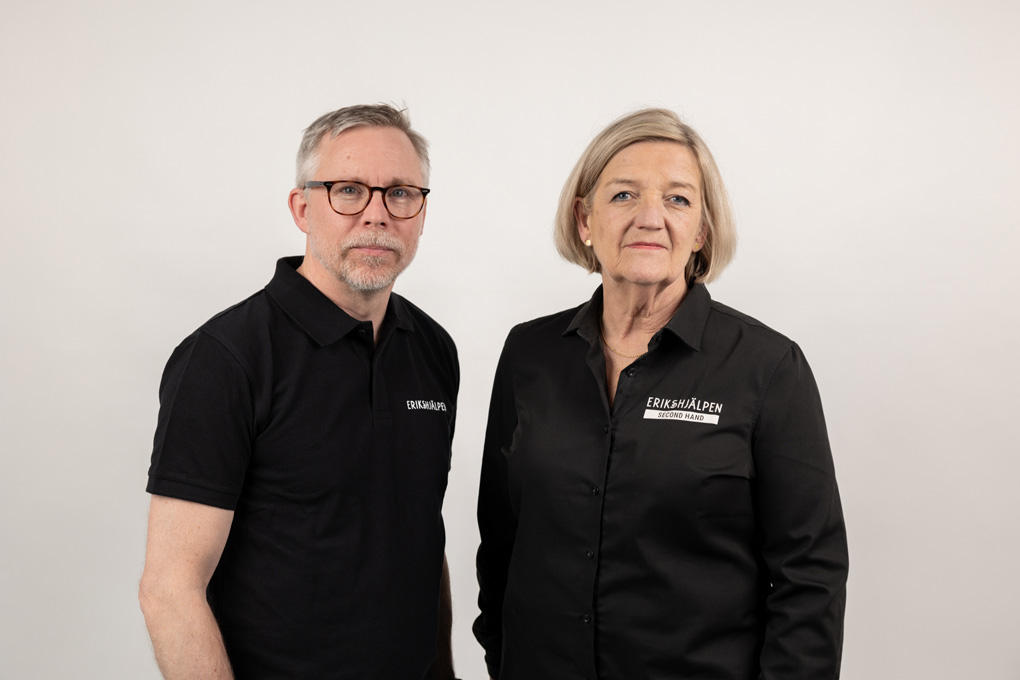
Mattias Ingeson Secretary General of Erikshjälpen & Anette Alm Gustafsson Managing Director of Erikshjälpen Second Hand
Mattias Ingeson Secretary General of Erikshjälpen & Anette Alm Gustafsson Managing Director of Erikshjälpen Second Hand
Unfortunately, surveys show that men still do very little second-hand shopping. According to a report by Tise (digital marketplace for second-hand clothing) Svenskarnas hållbara köpvanor, almost twice as many women as men shop on the second-hand market. 27% of women are equally satisfied with buying second-hand as new, compared to 14% of men. Almost twice as many women (40%) as men (24%) plan to choose second-hand products over new ones in the coming quarter, according to Prisjakt's Consumer Compass 2024 report.
The fact that so few men shop circularly is often said to be due to the supply. A supply that is created by women who donate to second hand. To create a reuse market that appeals to more men, more men also need to donate to second hand. We also see an overwhelming majority of women who are ambassadors and inspirers of circular consumption. Far too few men have taken on the mantle of sustainability in social media.
If we get the men as circulators and inspirers, we can move Sweden's Over Shoot Day forward in the future. Not just for the sake of the planet and future generations. We need to do it in solidarity with those countries that today lack the means to meet their basic needs. High-consumption countries like Sweden need to reduce their ecological footprint so that other countries have the opportunity to increase theirs, in a way that keeps us within the planet's limits.
But now is the time. As individuals, we need to make changes to ensure a sustainable future for all. It starts with ourselves, with our daily choices. By reducing our consumption, choosing sustainable options and inspiring others to do the same, we can make a real difference to our planet.
To postpone Sweden's Overshoot Day, we need:
- Consume less and, at the risk of generalizing, consume according to traditional male shopping behaviour. Somewhat reluctantly, carefully selected, higher quality goods, and more rarely.
- Consume like women - circularly. Because it is only when we reduce the amount of new consumption and at the same time switch to circular consumption that we can achieve the goal, i.e. the level of consumption that our planet can sustain.
Author:
Mattias Ingeson, Secretary General Erikshjälpen
Anette Alm Gustafsson, Managing Director Erikshjälpen Second Hand
The issue of VAT on second-hand goods has once again been raised, both by the government and within the Swedish Trade Federation. Erikshjälpen Second Hand welcomes the discussions that will promote the circular transition, but also wants to bring the non-profit perspective into the debate. Abolishing VAT on second-hand goods does not mean leveling the playing field, but pulling the rug out from under non-profit actors.
In 2016, it was decided that non-profit second-hand shops would continue to be exempt from VAT on the basis of their public benefit activities. The non-profit organizations would, if we compete on equal terms with the commercial players, otherwise "risk suffering from deteriorating conditions with cutbacks as a result". This concern still exists today.
Recently, it was announced that the government is launching an investigation into whether it is possible to simplify the regulations for Corporate that sell second-hand goods and for Corporate that want to donate goods to charity. The Swedish Trade Federation comments on the news that there are no investigations into the VAT rate. "The double taxation that currently applies to second-hand goods sold by commercial Corporate is hampering further steps in the transition. We fundamentally agree with this statement and the double taxation is difficult to defend. However, for the sake of the environment, legislation that addresses the problem of overproduction and the ever-increasing sale of newly produced goods is needed in the first place. Perhaps it should be a little complicated for companies, not so that they choose to discard goods instead, but so that the consequences of overproduction are actually allowed to be both costly and tangible. It is an incentive to review their business idea. It is not circular to continue producing new products and then give away what has not been sold.
Anette Alm Gustafsson, Managing Director Erikshjälpen Second Hand
Cathrine Kylesten, Sustainability Manager Erikshjälpen Second Hand
Anette Alm Gustafsson, Managing Director Erikshjälpen Second Hand
Cathrine Kylesten, Sustainability Manager Erikshjälpen Second Hand
It is positive that the Swedish Trade Federation is pushing for better conditions for the entire second-hand industry. We welcome reduced VAT or VAT exemption for the sake of the environment and the transition. But it also raises concerns among us non-profit second-hand actors when our competitive advantages are to be erased. The second-hand market needs to grow and new consumption needs to decrease - but abolishing VAT completely for commercial second-hand shops would distort competition and affect non-profit second-hand shops, which are an important part of civil society.
The better the conditions for commercial players, the harder it will be for us non-profit forces to be heard through the noise. We are already competing against private companies with heavy investors and hefty marketing budgets behind them, where the profits go to the shareholders. With non-profit second hand, the profits go back to sustainable social development through extensive social work, in addition to the environmental benefits of recycling.
Today, non-profit second-hand shops enjoy competitive advantages precisely because we are non-profit;
- We run a social work for people far from the labor market
- We offer space for engagement and community through volunteering
- Our surplus is reinvested in the sustainable development of society, locally and globally.
A further question to consider is for whom is the simplified or reduced VAT intended? Other examples of changing tax rates to drive new behaviors, such as the one on repairs, show that reduced VAT has not led to lower prices for consumers. And thus not a change in consumer behavior. Reducing VAT on commercial second-hand goods would make it easier for businesses, but will it lead to more people actually shopping sustainably?
Non-profit second-hand cannot be compared with the commercial sector. As just one of Sweden's non-profit second-hand operators, we have around 4,000 employees, a large proportion of whom are trainees in work training or wage subsidy positions on their way to or back to a working life.
Whether VAT is simplified, reduced or abolished altogether will have a decisive impact on the competitiveness of non-profit actors in relation to the increasing number of commercial actors entering the reuse market.
We welcome discussions with both the Swedish Trade Federation and the government on how the circular transition can be promoted, while civil society is given continued opportunities to contribute to the benefits of society.
Author:
Annette Alm Gustafsson, Executive Director of Erikshjälpen Second Hand
Cathrine Kylesten, Sustainability Manager Erikshjälpen Second Hand
 Listening
 This is a response to an opinion piece published in JP.
In Staffan Eklöf's (SD) and Ida Kors' (SD) opinion piece in JP on January 17, the Sweden Democrats write that the fears of introducing safety zones are exaggerated and that the risks are not proportionate to the potential gains. "The possibility of saving a child from being recruited into criminal networks outweighs the risk that a child may experience mistrust."
SD also believes that it is the politicians who have fed foreign-born people the idea that they are discriminated against. They cite an example from Erikshjälpen Framtidsverkstad , where young people feel that everyone dislikes people who live in the suburbs.
That is not the case, of course, but we cannot question the experience of young people. The fact that those subjected to suspicion and searches experience a lack of trust and confidence in the police and society is not a risk but already a reality. Several studies show that discrimination, stigmatization and racism are a fact of life in our society, factors that also deeply concern the UN Committee on the Rights of the Child.
Daniel Grahn, Secretary General Erikshjälpen
Birgitta Johansson, Head of Erikshjälpen Sweden
Daniel Grahn, Secretary General Erikshjälpen
Birgitta Johansson, Head of Erikshjälpen Sweden
Link to public society
Erikshjälpen Framtidsverkstad meets children, young people and parents in several of Sweden's underprivileged areas. We listen and make their voices visible and want to be a link to public society, which many lack confidence in. We often meet children and young people who have lost faith in themselves and their opportunities.
Violence and crime must be stopped, while we need to build trust in our society. Tougher measures are not enough. Children are both victims and perpetrators, according to Police Commissioner Karin Götblad in her Winter Chat, and describes how children end up in a predicament from which there is no escape. She also points out that collaboration between authorities and an inclusive civil society is necessary. "Society needs to be better at understanding the vulnerability of young people.
Same rights
the United Nations Convention on the Rights of the Child is clear: All children have the same rights, no matter where they live. That is not the case today, and as recently as last year, Sweden was criticized by the UN Committee on the Rights of the Child for failing to eliminate disparities and discrimination based on place of residence.
Erikshjälpen Framtidsverkstad wants to contribute to the realization of every person's potential. This is done by supporting children, young people and parents to be agents of change, both in their lives and in their neighborhood.
It also helps to break the isolation that otherwise risks being passed on. It is not about dressing capable people in "victim's clothing", but encouraging and supporting them to believe in their abilities to influence their future.
This is what a 15-year-old participant in one of Erikshjälpen's Future Workshops says:
"Before, nobody cared about us or our future, not even ourselves. With the Future Workshop, we are not only changing the view of our neighborhood, we are also changing ourselves as people."
People should not be so easily offended, say Staffan Eklöf and Ida Kors. But feeling offended is a personal experience, and it's not something that anyone else can decide if you are. The feeling can only be changed through positive experiences.
Safety zones counterproductive
Special safety zones are a short-term intervention that risks being counterproductive and reinforcing already negative circles. Reinforcing the image that many people already have of these areas, but also how the children living there see themselves. There is no doubt that all forms of crime and violence must be tackled and criminals prosecuted, but this means that everyone should be equal before the law, regardless of their address. We must not forget that most people living in deprived areas are ordinary people, who want to live and have a good life with a job, a home and a family.
Author:
Daniel Grahn, Secretary General of Erikshjälpen.
Birgitta Johansson, Head of Erikshjälpen Sweden.
Right now, a terrible humanitarian disaster is unfolding in Gaza, affecting children and others, and it will mark the Middle East and the world for many years to come.
The situation is unbearable.
Daniel Grahn, Secretary-General of Erikshjälpen.
Daniel Grahn, Secretary-General of Erikshjälpen.
- The situation is unbearable, it is terrible that the hope for peace and reconciliation in the region may have been shattered for several generations to come," says Daniel Grahn, Secretary-General of Erikshjälpen.
In conflict, children are particularly vulnerable and war is the ultimate violation of children's rights. Yet it is increasingly common for schools, hospitals and residential buildings to be targeted by warring countries. A strategy that goes against all humanitarian law and human dignity.
- "There is nothing as diabolical as attacking children, using them as shields or weapons," says Daniel Grahn.
Recently, the death toll in Gaza exceeded 25,000, mostly civilians and a third of them children. Those who survive bombs and ground battles risk dying instead from disease, starvation and dehydration, unless humanitarian aid arrives in time.
There is nothing as devilish as attacking children.
Erikshjälpen does not have its own staff on the ground or carry out any direct work in the region, but we are following developments closely.
- The war that affects innocent children on both sides is completely indefensible. We condemn every single child abuse, regardless of which side of the border it takes place.
Erikshjälpen calls on all parties involved in the conflict to respect international humanitarian law and put children's rights first. In our role, we appeal to the Swedish government to do everything in its power to reach a lasting ceasefire.
Violence against children in Gaza and Israel must stop!
Contribute to the relief effort in Gaza
Erikshjälpen does not assist with humanitarian interventions in Gaza, but we encourage you to contribute to the following organisations that do important work on the ground:
Give a gift to those affected in Gaza, diakonia.se
Humanitarian crisis in Gaza, imsweden.se
Children in Gaza and Israel must be protected, raddabarnen.se
Urgent need for aid in Gaza, rodakorset.se
Caption: Staff from Individual Humanitarian Aid's (IM) partner organization Palestinian Medical Relief Society (PMRS). Photo: PMRS.
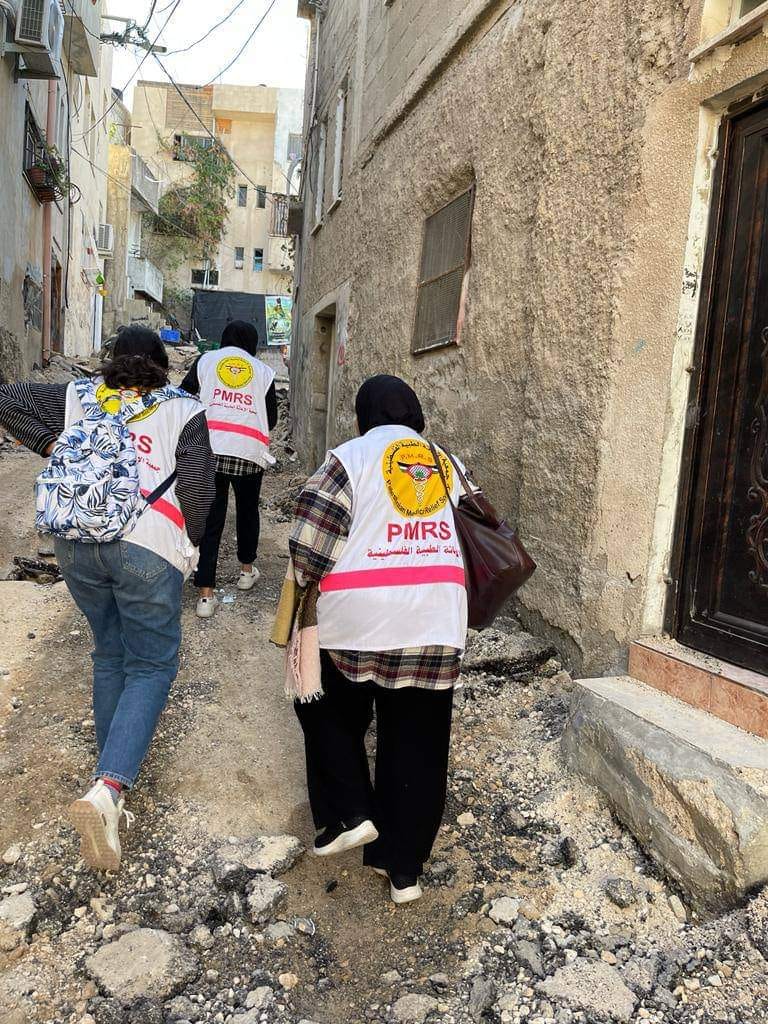
Photos with medical staff are from Individual Humanitarian Aid's (IM) partner organization Palestinian Medical Relief Society (PMRS).
Author: Daniel Grahn
The circular trade of reused goods is predicted to have a bright future with strong growth in the coming years. Our Second-Hand shops will then become increasingly important as wallets become thinner and the climate more fragile.
The Swedish Trade Federation recently presented its Style Index, summarizing the fashion industry's sales development over the past year. It has been a tough year with an even tougher ending for clothing retailers, and the outlook is no brighter. Clothing retailers recorded an increase of only 0.3% year-on-year in December and a 2% increase over the whole year.
The huge volumes of clothes put on the market are a threat to children's safety.
The decline in the clothing trade is a natural consequence of economic development, but we would like to think that part of it also has to do with increased awareness and the realization that the climate and nature crisis is a serious matter that needs to be addressed now. The huge volumes put on the market, with no real demand and no chance of good management at their untimely end-of-life, are a threat to children's safety, now and in the future.
Emelie Johansson, Environmental Strategist.
Emelie Johansson, Environmental Strategist.
When Erikshjälpen Second Hand now summarizes its year 2023, we can see that circular trade is here to stay. In 2023, sales of adult clothing increased by 8 percent. This means a turnover of 1,268,654 garments in our stores. In total, Erikshjälpen Second Hand also increased its total sales by 10 percent in 2023 and an increase of 9 percent in the number of customers.
What is produced must be of a design and quality that can be reused.
Our hope is that fashion producers will allow this period of economic downturn to be a reflection on the problem of volume. In 2023, it has become clearer than ever that there is no circular value chain in the fast fashion system. It is high time for change. Let's see reduced volumes of newly produced fashion on the market and make sure that what is produced is of design and quality that can be reused. This is a win-win for retailers, us and future generations.
Author: Emelie Johansson
Before Christmas, the Government and the Sweden Democrats presented their reform agenda for Swedish aid. There is much in the reform agenda that raises concerns for the countries that need the most support.
There are some positive elements in the government's new aid policy, but above all there are many concerns.
Anders Malmstigen, International Director at Erikshjälpen.
Anders Malmstigen, International Director at Erikshjälpen.
Concerns about the link between trade and aid
- "There are some positive elements in the government's new aid policy, but above all there is much that raises concern. One example is the clear link between trade and aid, which now leads to turning its back on some of the countries that need the most support," says Anders Malmstigen, International Director of Erikshjälpen.
"Aid for a new era - Freedom, empowerment and sustainable growth" is the name of the government's reform agenda that will determine the direction of Sweden's future global development work.
When the government's aid reform agenda was released in early December, Erikshjälpen eagerly awaited the letter of regulation to Sida to see what specific consequences the new reform agenda would have. The regulation letter with directives for Sida's activities came the following week and is largely in line with the changes contained in the reform agenda.
Aid policy has shifted focus from poverty reduction to promoting trade and development.
- "It is clear that the focus of aid policy has shifted from poverty reduction to primarily promoting trade and development," says Anders Malmstigen.
The concern about the link between trade and aid is that Sweden's aid policy is moving away from conflict-affected countries where poverty is increasing. This applies, for example, to Burkina Faso, Mali and South Sudan, countries where Erikshjälpen is active and where needs have increased.
The government's directive to Sida for 2024 now confirms that aid to these three countries in Africa, together with Cambodia in Asia, is being phased out within the framework of ongoing regional support. In the four countries that are being phased out, Erikshjälpen has interventions together with local partner organisations.
- The letter confirmed the concern that Sweden's aid no longer focuses primarily on people living in poverty and oppression. "Now our work and that of other civil society organizations becomes even more important. We can't just sit back and watch Swedish interests dictate who gets aid," says Anders Malmstigen.
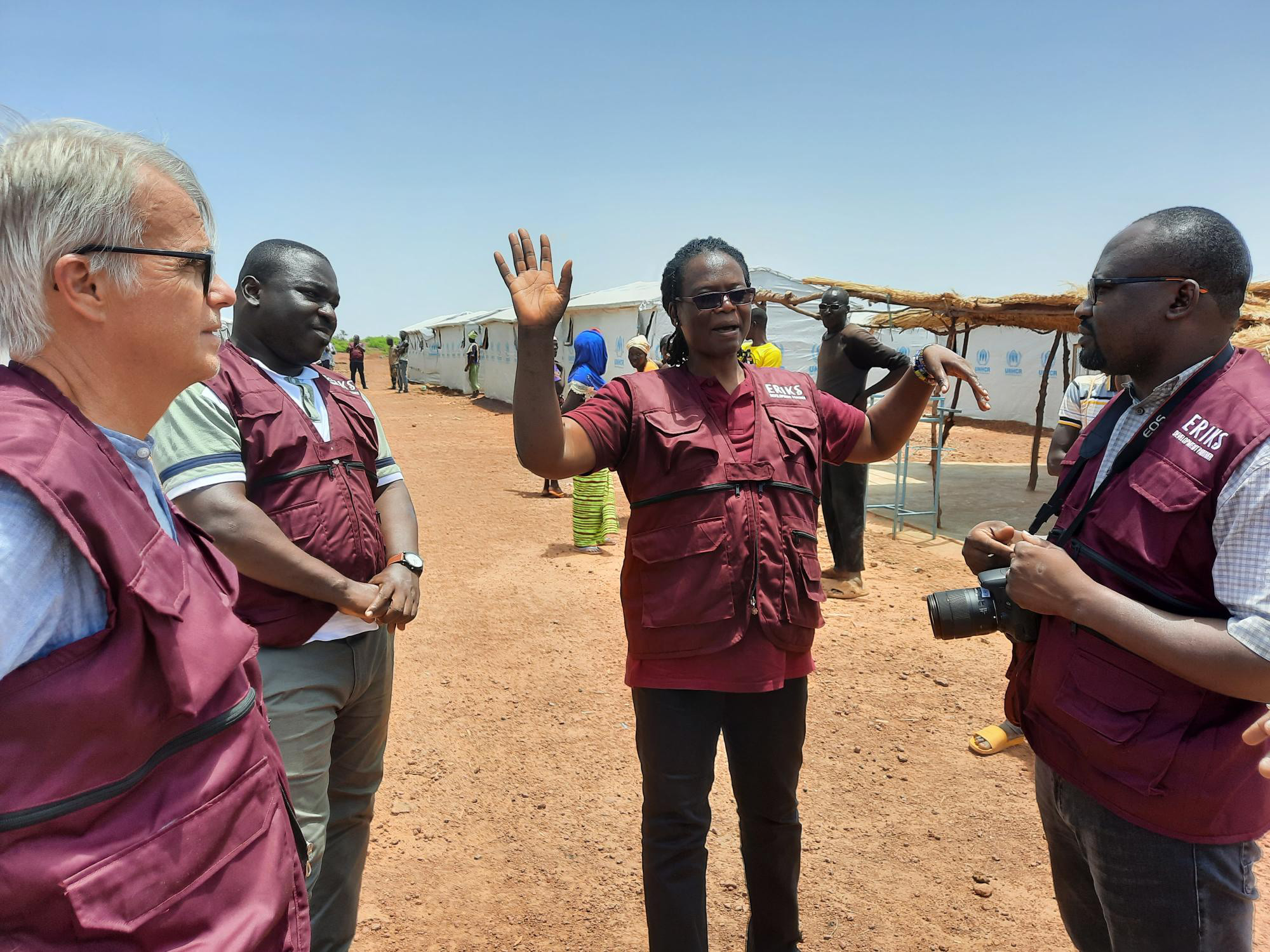
Anders Malmstigen together with Erikshjälpen's employees in Burkina Faso.
Anders Malmstigen together with Erikshjälpen's employees in Burkina Faso.
Now our work and that of other civil society organizations becomes even more important.
Analysis of the reform agenda and appropriation directions
Concord Sweden is an umbrella platform that brings together 82 aid organizations in civil society. In its analysis of aid policy and the appropriation letter to Sida, Concord highlights a few points in particular:
- The general condition that the funds may only be used in accordance with the OECD/DAC guidelines for what can be classified as aid is not included in the appropriation directions.
- The appropriation line for communication and information activities in Sweden is removed completely.
- There will be the same low allocation for aid through Swedish popular movement organizations (CIVSAM allocation) as last year.
During the year, Erikshjälpen worked with the Concord Sweden network to develop recommendations for what the government's aid reforms should look like for sustainable global development. An important piece of the puzzle has been to ensure that the promise of increased Funding to civil society can be kept.
The reform agenda indicates that future cooperation with civil society organizations is a priority, but there are no clear strategies.
- Now it is just a matter of ensuring that this is put into practice. "Even though the aid provided through Swedish NGOs has increased proportionally, we are still seeing a decrease in actual money. This is because the total volume of aid has decreased," says Anders Malmstigen.
The reform agenda is positive
In the government's reform agenda for aid, Erikshjälpen welcomes the fact that children are highlighted as a priority group with their own specific rights and that the rights and freedoms of girls are given a prominent position. Sexual and reproductive health and rights, SRHR, and working against, for example, genital mutilation are also on the agenda, which bodes well for the future. But it is now important that children's rights are made visible in future strategies in order to have a proper impact.
Analysis of the aid reform agenda, concord.se.
Analysis of appropriation directions to Sida, concord.se.
Read Anders Malmstigen's opinion piece on the subject in Dagen, Sweden phases out aid to particularly vulnerable countries, Dagen.se.
Author: Lena Elf.